Arsenal vs Chelsea: How Arteta’s Inverted Dynamics Neutralized Wide Counter-Threats
Emeka Okafor (Senior Analyst)
Football Journalism & Analytics
The London Derby Blueprint
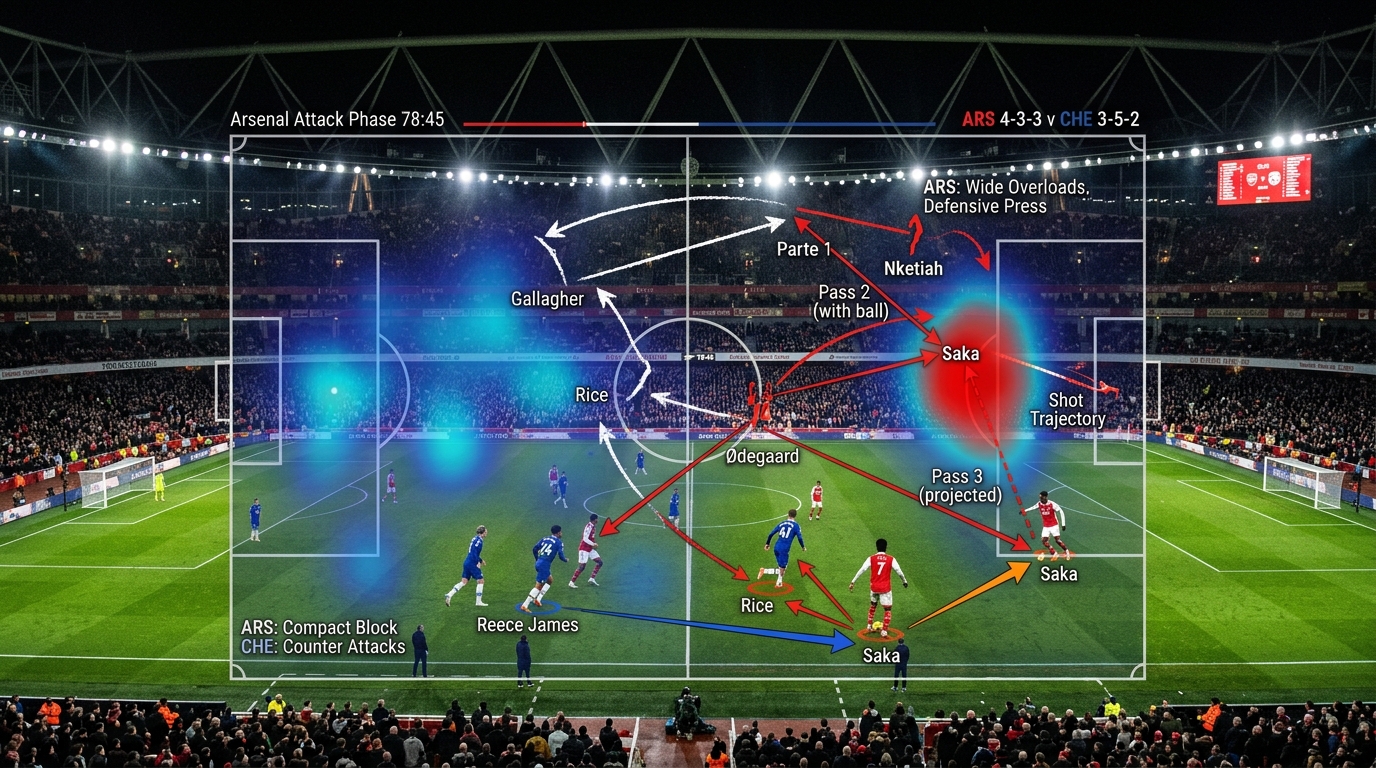
When Arsenal met Chelsea under the floodlights at the Emirates Stadium, the headline battle was always going to center on transition security versus wide counter-attacking pace. Mikel Arteta introduced a modified rest-defense framework that fundamentally dictated the tempo from the opening whistle.
Inverting the Full-Backs to Secure the Half-Spaces
Rather than pushing both full-backs high along the touchline, Arsenal inverted their left-back into a compact central double-pivot alongside Declan Rice. This formed an asymmetrical 3-2-5 structure in possession that had two crucial effects:
- Central Superiority: Chelsea’s midfield trio was constantly pinned between Martin Ødegaard’s half-space movements and the second-line ball circulation.
- Rest Defense Wall: When possession was turned over, Arsenal had five players stationed behind the ball in central corridors, forcing Chelsea into low-percentage wide clearances rather than vertical line-breaking counters.
Expected Goals (xG) and Tactical Verdict
While the final scoreline captured the headlines, the underlying metrics were even more decisive. Arsenal generated 2.14 expected goals (xG) while limiting Chelsea to just 0.42 non-penalty xG, with zero big chances conceded in open play. In modern football prediction, identifying teams with structurally sound rest defense provides far greater predictive signal than raw shot volume.