Manchester City vs Real Madrid: Deconstructing High-Line Pressing vs Transition Lethality
Emeka Okafor (Senior Analyst)
Football Journalism & Analytics
Clash of Footballing Philosophies
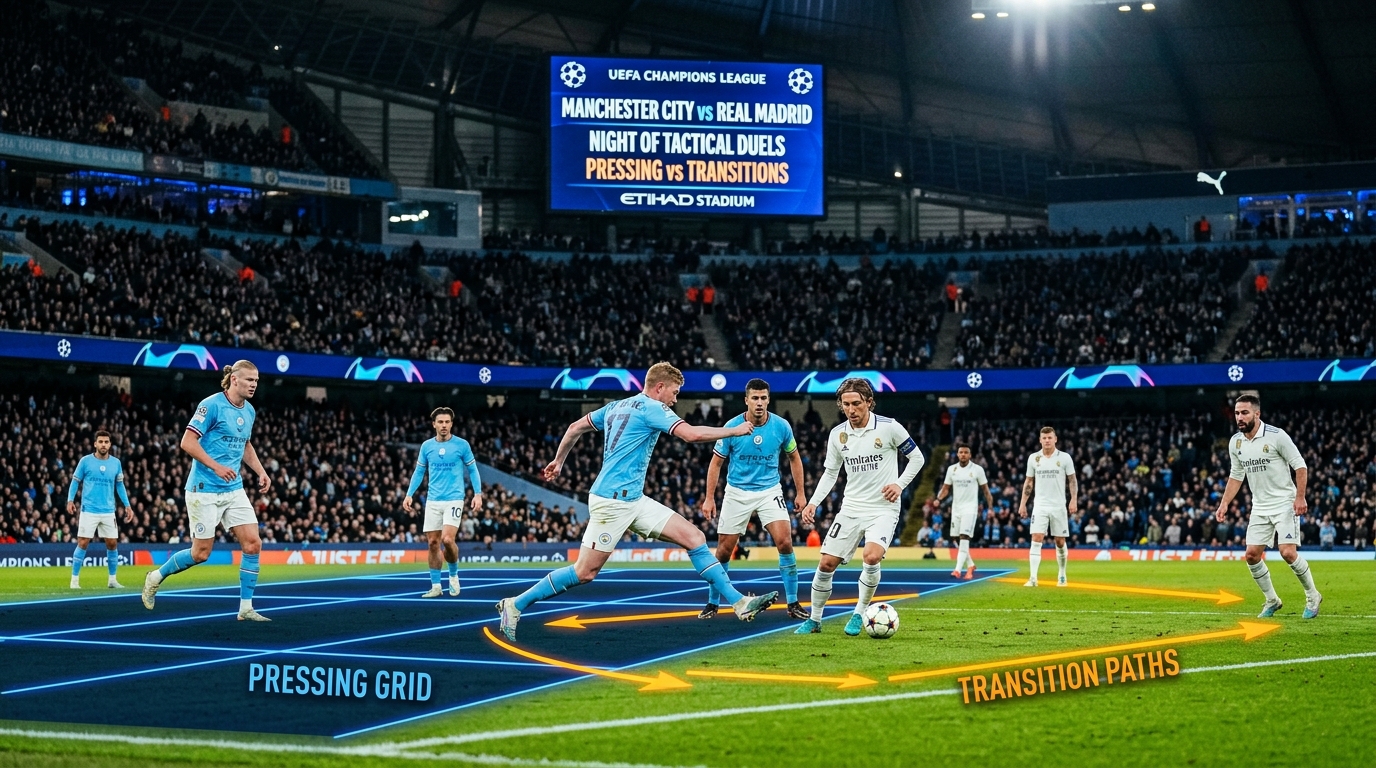
Few fixtures in world football offer the stark tactical contrast of Manchester City taking on Real Madrid in the UEFA Champions League. This encounter represented the ultimate friction point: positional suffocation versus transition precision.
Guardiola’s Box Midfield Geometry
Pep Guardiola deployed a 3-box-3 build-up structure designed to overload the center circle and isolate Madrid’s double pivot. With Kevin De Bruyne and Phil Foden occupying the pockets between the lines, City repeatedly created free-man passing angles that pushed Madrid into a deep 5-3-2 low block.
How Real Madrid Punished the High Line
Yet Carlo Ancelotti’s European pedigree lies in patience. Knowing City’s center-backs would station themselves 45 meters from their own goal line, Real Madrid bypassed the first pressing wave with diagonal lofted balls into the channels for Vinícius Júnior and Jude Bellingham.
"Against a suffocating press, you do not beat the press with five short passes; you beat it with one vertical pass executed with mathematical perfection."
Predictive Takeaways
Whenever elite possession teams face supreme counter-attacking sides, betting models often overvalue possession share. In our Sportifem Max tier analysis, calculating Direct Speed to Goal (meters per second of ball progression) provided the crucial edge over raw territorial metrics.